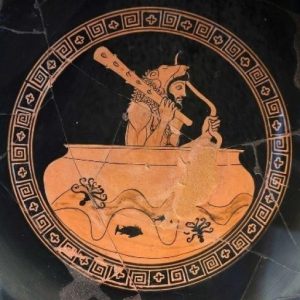
The Labours of Heracles: A Literary and Artistic Examination – PDF

Note: My blog is not monetized. The media below has been posted for educational purposes only. If you enjoyed this version, please, please, please support the official release.

Gibbons, Susan E. “The Labours of Heracles: A Literary and Artistic Examination.” PhD diss. London University, 1975.

(Free PDF link above)

Abstract

This thesis is primarily concerned with the documentation of the artistic and literary evidence for each of the traditional twelve labours of Heracles, in the course of which I have made certain discoveries relating to the concept and content of the labours.

Heracles is made to perform labours at least as early as the Iliad. The Greeks generally referred to them as ἆθλοι, contests in return for a prize, in this case immortality. It is not until the fifth century B.C. that a specific number is defined, namely twelve, by a fragment of Pindar and the metopes of the Temple of Zeus at Olympia. The Cerberus, lion, and hind labours and possibly those of Geryon and the hydra were defined as such before the metopes, which provide a very early and isolated appearance of all the twelve labours of the later canon. I believe these metopes show Elis claiming Heracles as her special hero to emphasise her newly-found identity.

As regards the myths which became the traditional labours, Cerberus, lion, hydra and Geryon date at least to the eighth century B.C., birds and possibly Amazons to the seventh, and the rest, with the possible exception of Augeas, to c. 550.

The characteristic feature of the labours is the exhibition of heroism: most involve fighting, often against monstrous opponents. Sometimes public benefaction is demonstrated but this is developed more by later writers. Many heroic deeds of Heracles could have been made into labours. The choice at Olympia seems to demonstrate Heracles’ close connection with the surrounding area highlighted by the labours he performed. in the remote corners of the Greek world as a panhellenic hero, It was not until the local nature of Olympia’s interpretation of the individual labours was forgotten that it was adopted as the canon.
The Iconography of Herakles and the ‘Other’ in Archaic Greek Vase Painting – PDF

Note: My blog is not monetized. The media below has been posted for educational purposes only. If you enjoyed this version, please, please, please support the official release.

Lawson, Pamela Jane. “The Iconography of Herakles and the ‘Other’ in Archaic Greek Vase Painting.” PhD diss. Harvard University, 1993.

(Free PDF link above)

Abstract

The iconography of Herakles’ mythical biography on the surface of vases in the sixth century served as the medium through which Greek artists explored and made comprehensible the opposing forces of civilized and savage, or nature and culture. A close examination of the way in which the artists chose to illustrate Herakles’ deeds, helps the viewer today to understand the true nature of Greek anxieties and hopes about the forces operating in their world. Such forces and oppositions represented visually in the archaic period are eventually subsumed by the Greek/barbarian antithesis developed in the fifth century. Herakles represents the antithesis of the Greek vs. barbarian internalized. Herakles can behave in ways that will be considered ’barbaric’ in the next century. However, negative qualities most associated with the barbarian later, are externalized in many of Herakles’ deeds, confusing and confining the antithesis. The ‘monster’ or beast may have been a ‘proto-barbarian’, and particular deeds bring Herakles into contact with anthropomorphic foes who practice ‘barbaric’ behavior. In fifth century literature, Greek attitudes about the barbarian have transformed and expanded. The necessity for a more clarified image of the Greek/ barbarian antithesis is motivated by philosophical developments and historical events. The idea of the barbarian is externalized and defined by authors such as Herodotus. In Greek Tragedy, the barbarian is now often the foil for the civilized Greek. Because undesirable qualities are transferred to the non-Greek, attempts are made in literature to justify Herakles behavior and to make him a citizen of the polis. Representations of Herakles in fifth century art illustrate a similar transformation, despite the general decline in the appearance of scenes featuring Herakles in attic vase painting of the period. This decline may be related to the transfer of most negative qualities expressed in the sixth century images of Herakles to the barbarian of the fifth century. The advent of tragedy and the juxtaposition of the Greek and the barbarian provided a new way to illustrate the varied nature of humanity while additionally celebrating the Greek, making the sixth century iconography of Herakles obsolete.