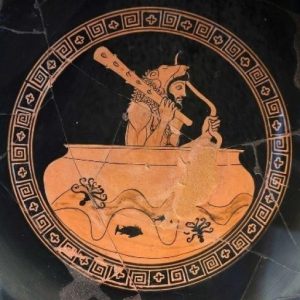
The Myths of Herakles as a Fighter – PDF

Grollios, A. D. “The Myths of Herakles as a Fighter.” Master’s thesis, University of Glasgow, 1984.

(Free PDF link above)

Thank you: I’m incredibly grateful to the University of Glasgow Library for scanning a physical copy of the thesis since the PDF I originally purchased from Proquest was flawed.

Summary

The present work examines the myths of Herakles as fighter, which are the myths where the hero appeared to confront a single opponent other than an animal or a monster. Those opponents are distinguished into Deities and Humans and the stories which narrate the fights of Herakles against them are classified accordingly into separate chapters in alphabetical order. A further distinction is made as regards the way the fights of Herakles were conducted: some of them involved the use of weapons but others were unarmed contests, almost exclusively wrestling matches. There is also a third chapter, which includes certain stories in which Herakles appeared to kill someone without a confrontation; those are called Killings and examined here because they still present the hero attacking a single individual. The stories under examination are reviewed as they appear in the sources; whenever the latter provide more than one versions [sic], those are all cited, irrespectively of their estimated validity. There follows an examination of various elements which are considered important in the stories, such as the way the contest between Herakles and his opponent was fought, the weapons which were possibly used, the result of the fight and its nature (whether a contest for a prize or a mere robbery, for example). The examination of all those myths where Herakles appears to fight a single individual leads to the conclusion that a significant number of Herakles’s opponents were either water-deities or descendants of Poseidon, the water-deity par excellence. That is taken to signify that Herakles should be ultimately considered a figure who is fundamentally opposed to water, a hero mostly suited to a non sea-faring people.

Grollios (1984) analyses this sixth-century BCE hydria featuring Heracles (standing) wrestling with Antaios (laying), while the gods watch (48). Image found here. The original watermarks have been removed, but this was only done so visitors could have an unobstructed view. This is for personal use only.

The Iconography of Herakles and the ‘Other’ in Archaic Greek Vase Painting – PDF

Note: My blog is not monetized. The media below has been posted for educational purposes only. If you enjoyed this version, please, please, please support the official release.

Lawson, Pamela Jane. “The Iconography of Herakles and the ‘Other’ in Archaic Greek Vase Painting.” PhD diss. Harvard University, 1993.

(Free PDF link above)

Abstract

The iconography of Herakles’ mythical biography on the surface of vases in the sixth century served as the medium through which Greek artists explored and made comprehensible the opposing forces of civilized and savage, or nature and culture. A close examination of the way in which the artists chose to illustrate Herakles’ deeds, helps the viewer today to understand the true nature of Greek anxieties and hopes about the forces operating in their world. Such forces and oppositions represented visually in the archaic period are eventually subsumed by the Greek/barbarian antithesis developed in the fifth century. Herakles represents the antithesis of the Greek vs. barbarian internalized. Herakles can behave in ways that will be considered ’barbaric’ in the next century. However, negative qualities most associated with the barbarian later, are externalized in many of Herakles’ deeds, confusing and confining the antithesis. The ‘monster’ or beast may have been a ‘proto-barbarian’, and particular deeds bring Herakles into contact with anthropomorphic foes who practice ‘barbaric’ behavior. In fifth century literature, Greek attitudes about the barbarian have transformed and expanded. The necessity for a more clarified image of the Greek/ barbarian antithesis is motivated by philosophical developments and historical events. The idea of the barbarian is externalized and defined by authors such as Herodotus. In Greek Tragedy, the barbarian is now often the foil for the civilized Greek. Because undesirable qualities are transferred to the non-Greek, attempts are made in literature to justify Herakles behavior and to make him a citizen of the polis. Representations of Herakles in fifth century art illustrate a similar transformation, despite the general decline in the appearance of scenes featuring Herakles in attic vase painting of the period. This decline may be related to the transfer of most negative qualities expressed in the sixth century images of Herakles to the barbarian of the fifth century. The advent of tragedy and the juxtaposition of the Greek and the barbarian provided a new way to illustrate the varied nature of humanity while additionally celebrating the Greek, making the sixth century iconography of Herakles obsolete.