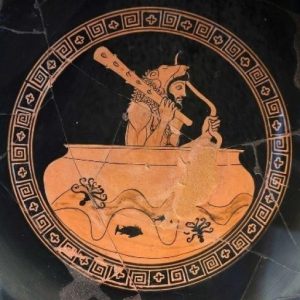
Here I present four translations of the famous parable “Hercules at the Crossroads,” also known as “The Choice of Hercules,” which describes the young demi-god pondering a choice between wasting his talents in a comfortable, fruitless life or putting them to good use in a challenging, yet rewarding life. Each path is personified by the goddesses Kakia (Vice) and Arete (Virtue), respectively, who seek him out specifically to sway his decision by debating the pros and cons of each future. The tale is attributed to the Sophist Prodicus and recorded by Xenophon in book two (2.1.21-34) of his Memorabilia (post-371 BCE).
First
The first comes from Xenophon (1923). It is my personal favorite of the bunch:
“Aye, and Prodicus the wise expresses himself to the like effect concerning Virtue in the essay ‘On Heracles’ that he recites to throngs of listeners. This, so far as I remember, is how he puts it: ‘“When Heracles was passing from boyhood to youth’s estate, wherein the young, now becoming their own masters, show whether they will approach Life by the path of virtue or the path of vice, he went out into a quiet place, and sat pondering which road to take. And there appeared two women of great stature making towards him. The one was fair to see and of high bearing; and her limbs were adorned with purity, her eyes with modesty ; sober was her figure, and her robe was white. The other was plump and soft, with high feeding. Her face was made up to heighten its natural white and pink, her figure to exaggerate her height. Open-eyed was she; and dressed so as to disclose all her charms. Now she eyed herself; anon looked whether any noticed her; and often stole a glance at her own shadow.
“When they drew nigh to Heracles, the first1 pursued the even tenor of her way: but the other, all eager to outdo her, ran to meet him, crying: ‘Heracles, I see that you are in doubt which path to take towards life. Make me your friend; follow me, and I will lead you along the pleasantest and easiest road. You shall taste all the sweets of life; and hardship you shall never know. First, of wars and worries you shall not think, but shall ever be considering what choice food or drink you can find, what sight or sound will delight you, what touch or perfume ; what tender love can give you most joy, what bed the softest slumbers; and how to come by all these pleasures with least trouble. And should there arise misgiving that lack of means may stint your enjoyments, never fear that I may lead you into winning them by toil and anguish of body and soul. Nay; you shall have the fruits of others’ toil, and refrain from nothing that can bring you gain. For to my companions I give authority to pluck advantage where they will.’
“Now when Heracles heard this, he asked, Lady, pray what is your name?’
” ‘My friends call me Happiness,’ she said, ‘ but among those that hate me I am nicknamed Vice.’
” Meantime the other had drawn near, and she said: ‘I, too, am come to you, Heracles: I know your parents and I have taken note of your character during the time of your education. Therefore I hope that, if you take the road that leads to me, you will turn out a right good doer of high and noble2 deeds, and I shall be yet more highly honoured and more illustrious for the blessings I bestow. But I will not deceive you by a pleasant prelude: I will rather tell you truly the things that are, as the gods have ordained them. For of all things good and fair, the gods give nothing to man without toil and effort. If you want the favour of the gods, you must worship the gods: if you desire the love of friends, you must do good to your friends: if you covet honour from a city, you must aid that city: if you are fain to win the admiration of all Hellas for virtue, you must strive to do good to Hellas: if you want land to yield you fruits in abundance, you must cultivate that land: if you are resolved to get wealth from flocks, you must care for those flocks: if you essay to grow great through war and want power to liberate your friends and subdue your foes, you must learn the arts of war from those who know them and must practise their right use: and if, you want your body to be strong, you must accustom your body to be the servant of your mind, and train it with toil and sweat.’
” And Vice, as Prodicus tells, answered and said : ‘Heracles, mark you how hard and long is that road to joy, of which this woman tells? but I will lead you by a short and easy road to happiness.’
” And Virtue said: ‘What good thing is thine, poor wretch, or what pleasant thing dost thou know, if thou wilt do nought to win them? Thou dost not even tarry for the desire of pleasant things, but fillest thyself with all things before thou desirest them, eating before thou art hungry, drinking before3 thou art thirsty, getting thee cooks, to give zest to eating, buying thee costly wines and running to and fro in search of snow in summer, to give zest to drinking ; to soothe thy slumbers it is not enough for thee to buy soft coverlets, but thou must have frames for thy beds. For not toil, but the tedium of having nothing to do, makes thee long for sleep. Thou dost rouse lust by many a trick, when there is no need, using men as women: thus thou trainest thy friends, waxing wanton by night, consuming in sleep the best hours of day. Immortal art thou, yet the outcast of the gods, the scorn of good men. Praise, sweetest of all things to hear, thou hearest not: the sweetest of all sights thou beholdest not, for never yet hast thou beheld a good work wrought by thyself. Who will believe what thou dost say ? who will grant what thou dost ask? Or what sane man will dare join thy throng? While thy votaries are young their bodies are weak, when they wax old, their souls are without sense; idle and sleek they thrive in youth, withered and weary they journey through old age, and their past deeds bring them shame, their present deeds distress. Pleasure they ran through in their youth: hardship they laid up for their old age. But I company with gods and good men, and no fair deed of god or man is done without my aid. I am first in honour among the gods and among men that are akin to me: to craftsmen a beloved fellow-worker, to masters a faithful4 guardian of the house, to servants a kindly protector: good helpmate in the toils of peace, staunch ally in the deeds of war, best partner in friendship. To my friends meat and drink bring sweet and simple enjoyment: for they wait till they crave them. And a sweeter sleep falls on them than on idle folk: they are not vexed at awaking from it, nor for its sake do they neglect to do their duties. ‘The young rejoice to win the praise of the old; the elders are glad to be honoured by the young; with joy they recall their deeds past, and their present well-doing is joy to them, for through me they are dear to the gods, lovely to friends, precious to their native land. And when comes the appointed end, they lie not forgotten and dishonoured, but live on, sung and remembered for all time. O Heracles, thou son of goodly parents, if thou wilt labour earnestly on this wise, thou mayest have for thine own the most blessed happiness.’
“Such, in outline, is Prodicus’ story of the training of Heracles by Virtue; only he has clothed the thoughts in even finer phrases than I have done now. But anyhow, Aristippus, it were well that you should think on these things and try to show some regard for the life that lies before you.”5
Second
The second is Xenophon (1990):
‘The same view of moral goodness is also set out by the sophist Prodicus in the story of Heracles, which is one of his most popular displays; it runs like this, as far as I remember. When Heracles was setting out from childhood towards manhood, at the age when the young become independent and show whether they are going to approach life by the path of goodness or by the path of wickedness, he went out to a quiet spot and sat down considering which way he should take. While he was sitting there, he thought he saw two women approach him. Both were tall, but one of them was handsome in appearance with a natural air of distinction, clean-limbed and modest in expression, and soberly dressed in a white robe, while the other was well fed to the point of fleshiness and softness, made up to have a complexion too red and white to be real, and with a carriage more upright than was natural, with a brazen expression, and robed in a way that revealed as much as possible of her charms. She kept on examining herself, and watching to see if anyone was looking at her, and glancing at her own shadow. When they got nearer to Heracles, the first of the two continued to advance in the same way, but the other, wishing to forestall her, ran up to him and said:
‘ “Heracles, I see that you can’t make up your mind which way of life to adopt. If you take me as your friend, I will lead you by the easiest and pleasantest road; you shall not miss the taste of any pleasure, and you shall live out your life without any experience of hardship. In the first place, you will not be concerned with wars or responsibilities; you shall constantly consider what food or drink you can find to suit your taste, and what sight or sound or scent or touch might please you, and which lover’s society will6 gratify you most, and how you can sleep most comfortably, and how you can achieve all these objects with the least trouble. And if there is ever any suspicion of a shortage of any of these benefits, you need not fear that I shall involve you in any physical or mental effort or distress in procuring them; you shall enjoy the fruits of other people’s labours, and you shall refrain from nothing from which you can derive any advantage, because I authorize my followers to benefit themselves from all quarters.”
‘When Heracles heard this, he asked, “What is your name, lady?” She replied, “My friends call me Happiness, but people who don’t like me nickname me Vice.
‘Meanwhile, the other woman came forward and said, “I too have come to meet you, Heracles, because I know your parents and I have carefully observed your natural qualities in the course of your education, and this knowledge makes me hope that, if you will only take the path that leads to me, you may become a very effective performer of fine and noble deeds, and I may win much greater honour still, and brighter glory for the blessings I bestow. I will not delude you with promises of future pleasure; I shall give you a true account of the facts, exactly as the gods have ordained them. Nothing that is really good and admirable is granted by the gods to men without some effort and application. If you want the gods to be gracious to you, you must worship the gods; if you wish to be loved by your friends, you must be kind to your friends; if you desire to be honoured by a State, you must help that State; if you expect to be admired for your fine qualities by the whole of Greece, you must try to benefit Greece; if you want your land to produce abundant crops, you must look after your land; if you expect to make money from your livestock, you must take care of your livestock; if you have an impulse to extend your influence by war, and want to be able to free your friends and subdue your enemies, you must both learn the actual arts of war from those who understand them, and practise the proper way of applying them; and if you want to be physically efficient, you7 must train your body to be subject to your reason, and develop it with hard work and sweat.”
‘Here Vice, as Prodicus tells, broke in. “Do you realize, Heracles,” she said, “what a long and difficult road to enjoyment this woman is describing to you? I will put you on a short and easy road to happiness.”
‘“Impudent creature!” said Virtue. “What good have you to offer, or what do you know of pleasure, you who refuse to do anything with a view to either? You don’t even wait for the desire for what is pleasant: you stuff yourself with everything before you want it, eating before you are hungry and drinking before you arc thirsty. To make eating enjoyable you invent refinements of cookery, and to make drinking enjoyable, you provide yourself with expensive wines and rush about searching for ice in summer. To make going to sleep pleasant, you provide yourself not only with soft blankets, but also with bases for your beds, for it is not work but boredom that makes you want to go to bed. You force the gratification of your sexual impulses before they ask for it, employing all kinds of devices and treating men as women. That is the sort of training that you give your friends — exciting their passions by night, and putting them to sleep for the best part of the day. Although you are immortal, you have been turned out by the gods, and you are despised by decent men. You are denied the hearing of the sweetest of all sounds — praise of yourself — and you are denied the seeing of the sweetest of all sights, for you have never contemplated any act of yours that was admirable. Who would trust your word? Who would assist you if you needed someone? What sane person would have the face to join your devotees? When they are young, they are feeble in body, and when they get older, they are foolish in mind, they are maintained in their youth in effortless comfort, but pass their old age in laborious squalor, disgraced by their past actions and burdened by their present ones, because in their youth they have run through all that was pleasant, and laid up for their old age what is hard to bear.
‘“I associate both with gods and with good men, and no fine8 action, human or divine, is done independently of me. I am held in the highest honour both among gods and men who are akin to me. I am a welcome fellow worker to the craftsman, a faithful guardian to the householder, a kindly protector to the servant, an efficient helper in the tasks of peace, a staunch ally in the operations of war, and the best partner in friendship. My friends can enjoy food and drink with pleasure and without effort, because they abstain until they feel a desire for them. Their sleep is sweeter than the sleep of the easy-living, and they neither are vexed when they have to give it up, nor make it an excuse for neglecting their duty. The young enjoy the praise of their elders, and the older people are happy in the respect of the young. They recall their past achievements with pleasure, and rejoice in their present successes, because through me they are dear to the gods, loved by their friends and honoured by their country. And when their appointed end comes, they do not lie forgotten in obscurity, but flourish celebrated in memory for all time. ‘“There, Heracles,” she said, “child of good parents: if you work hard in the way that I have described, you can possess the most beatific happiness.” ‘That is roughly how Prodicus describes the education of Heracles by Virtue, except that he actually dressed up the sentiments in language still more splendid than I have used now. At any rate, Aristippus, you had better think this over and try to take some account of the factors that will affect the life that lies in front of you.’9
Third
The third is Xenophon (1994):
[21] “And Prodicus the wise declares a similar view of virtue in his treatise about Heracles—the very one he displayed most widely—when he says something like the following, insofar as I recall. For he says that when Heracles was starting to enter ado-10 lescence from childhood—when youths, since they are already becoming their own rulers, make clear whether in life they will take the road through virtue or that through vice—going out to a quiet spot, he sat down perplexed as to which of the roads he should take.
[22] “And two tall women appeared to him to be approaching. One of the two was becoming to look at and freeborn in nature. For adornment her body had purity her eyes modesty, her bearing moderation, and she had white clothing. The other had been fed to the point of being fleshy and soft. She was prettied up so that her complexion seemed to appear whiter and rosier than its reality, and so that her bearing seemed straighter than its nature. Her eyes were wide open, and she was wearing the clothes in which her bloom would be most conspicuous. She looked down at herself frequently, looked around to see if anyone else was looking at her, and frequently looked at her own shadow.
[23] “When they came nearer to Heracles, the one spoken of first went on in the same manner, but the other, who wished to reach Heracles first, ran to him and said, ‘I see, Heracles, that you are perplexed as to which road you should take in life. If you befriend me, I will lead you to the most pleasant and easiest road; you will not miss the taste of any delight, and you will live your life without experience of the hard things.
[24] ” ‘First, you will worry neither about war nor about business. Instead, you will roam about examining what delightful food or drink you might find, what delight you might see or hear, what pleasant things you might smell or touch, which favorites would especially delight you in associating with them, and how you might sleep most comfortably, and how you might obtain all these things with the least trouble.
[25] ” ‘And if ever any suspicion should arise that the sources11 of these things will be scarce have no fear that I might lead you to procure these things for yourself by means of labor and hardship of body and soul. Instead, you will use whatever methods others use to accomplish these things and refrain from nothing gainful. For I, for my part, furnish my companions with the license to derive benefit from wherever they may.’
[26] “And Heracles, after hearing these things, said, ‘Woman, what is your name?’
” ‘My friends call me Happiness,’ she said, ‘but those who hate me nickname me Vice.’
[27] “At this point the other woman approached and said, ‘I too have come to you, Heracles, since I know those who begot you and that nature of yours, having observed it in your education. Therefore, I have hope: for you, that if you should take the road toward me, you will become an exceedingly good worker of what is noble and august; and, for me, that I will appear still far more honored and more distinguished for good things. I shall not deceive you with preludes about pleasure. But I shall truthfully describe the disposition the gods have made of the things that are.
[28] ” ‘For without labor and attentiveness the gods give humans none of the things that are good and noble. But if you wish the gods to be gracious to you, you must serve the gods; if you want to be cherished by your friends you must do good deeds for your friends; if you desire to be honored by some city, you must benefit the city; if you think you deserve to be admired by all Greece for your virtue you must attempt to be the cause of good for Greece; if you wish the earth to bear you fruit in abundance, you must serve the earth; if you think you must become rich from cattle, you must be attentive to the cattle; if you set out to increase yourself through war and wish to be able to make your friends free and subdue your enemies, you must learn the warlike arts themselves from those who understand them, as well as practice how one must use them. And if you wish to be powerful also in your body, you must accustom your body to serve your judgment, and you must train with labors and sweat.’12
[29] “And Vice interrupted her and said—as Prodicus tells it—’Reflect, Heracles, how hard and long is the road to the delights that this woman describes for you. But I shall lead you to an easy and short road to happiness.’
[30] “And Virtue said, ‘Wretch! What good thing do you have? Or what pleasant thing do you know, not wanting to do anything for the sake of these things? You do not even await the desire for pleasures but rather fill yourself up with everything before desiring it, eating before you are hungry, drinking before you are thirsty. In fact, in order to eat pleasantly you contrive gourmet cooks; in order to drink pleasantly you furnish yourself with costly wines and in summer run around seeking ice; and in order to sleep pleasantly you furnish yourself not only with soft bedclothes but couches and rockers for your couches. For you desire sleep not because of your labor but because you have nothing to do. And you compel (yourself to have) sex before you are in need, contriving all sorts of things and treating (chrēsthai) men as women. Insolent at night and asleep during the most useful part of the day, this is the way you educate your friends.
[31] ” ‘Although you are immortal, you have been cast out from among the gods and are dishonored by good human beings. You have not heard the most pleasant of all sounds, praise of yourself. And you have not seen the most pleasant of all sights, for you have never seen any noble work of your own. If you should say anything, who would trust you? If you should need anything, who would supply you? And what person of good sense would dare to be among your worshippers, who are powerless in their bodies when young and senseless in their souls when they become older, who are comfortably sustained without labor through youth, and pass a miserable and laborious old age, who are ashamed by what they have done and weighed down by what they are doing, and who run through pleasures in their youth and lay up the hard things for old age.
[32] ” ‘But I am a companion of the gods, and a companion of good human beings. No noble work, divine or human, comes into13 being without me. I am honored most of all among gods and among those human beings by whom it is fitting to be honored; for I am a cherished coworker for artisans, a trusted guardian for masters of households, a well-disposed assistant for household servants, a good helper for the labors of peace, a reliable ally for the works of war, and an excellent partner in friendship.
[33] ” ‘Among my friends the enjoyment of food and drink is pleasant and trouble free, for they refrain from these until they desire them. More pleasant sleep is available to them than to those who do not toil. And when they lose sleep they are not annoyed, nor on this account are they remiss in taking the actions they should. The young delight in praise from their elders, while the old exult in honors from the young. They recall their former actions with pleasure and are pleased when they do well in present ones, being, because of me, dear to gods, cherished by friends, and honored by fatherlands. And whenever their allotted end comes, they do not lie without honor and forgotten but thrive remembered in hymns sung through all time. When you have worked hard at such things, Heracles, child of good parents, it is possible to possess the most blessed happiness.’
[34] “Prodicus managed the education of Heracles at the hands of Virtue more or less in this way. He, however, decorated his judgments with wording even grander than I used just now. So it’s worthwhile for you, Aristippus, with these things in mind, to try to worry somewhat also about the future things of your life.”14
Fourth
I first learned about the parable from Matyszak (2015), so I figured I should probably add it to the mix. The deletions are original to the source:
He [Hercules] took himself to a quiet place and there sat to contemplate. As he pondered which path to take, he saw two women approaching. Both were of15 unnaturally large stature, but one was fair and proud. Her limbs were pure, and her eyes were modest. Austere was her figure, and her robe was white.
The other was plump and soft from good meals. Make-up emphasised the natural white and pink of her face, and her clothing exaggerated her height and displayed rather than hid her charms. Doe-eyed, she admired herself and her own shadow, before quickly glancing about to see who else might have noticed her.
The first kept up her even pace as she approached, but the other pushed past, eager to be there first. ‘Heracles, I see that you considering which path of life you should take. Befriend me. Follow me, and your road will be pleasant and easy. You will never know hardship, and all the sweet things of life will be yours. Forget wars and worries – your cares will be what choice food or drink you prefer, and what sights and sounds most delight you. What touch or perfume most pleases, whose tender love you most enjoy, what bed yields the softest slumbers; and how little effort you need expend to obtain these.’
‘You’ll never need worry you can’t afford your luxuries, or fear that I’ll make you win them by straining body and soul in effort. Others will do the work for you, and hold back nothing. Those who follow me have my permission to take whatever they want.’
On hearing this Heracles asked ‘Please tell me, Lady, what is your name?’ She replied ‘My friends call me Happiness. Those who hate me call me Vice.’
All the while the other had kept up her approach. Now she too spoke. ‘I also have come for you, Hercules. I know your parents and have followed your education. It is my hope that you will take the road that leads to me. You will become one who does great and noble things, and in doing them through my gifts, I too will become more illustrious and honoured. But let not this pleasant introduction deceive you – I intend to talk plainly about the way things are, and how the Gods have decreed they must be. ‘
‘For the Gods have decreed that nothing worthwhile comes to man but that he works to earn it. To earn the favour of the Gods, you must worship the Gods. Desiring the love of friends, you must do good for them … and if you want your body to be strong, you must make it the servant of your mind, and train it with effort and sweat.’
Hearing this, Vice remarked, ‘You hear what this woman says, Heracles?16 The road to joy is hard and long. Let me take you down the short and easy path to happiness.’
And Virtue retorted, ‘You poor creature. What good thing is yours, or what worthwhile knowledge, if you have done nothing to earn it? You can’t even wait for desire, but get things before you want them. You eat before you are hungry and drink before you are thirsty. … You are wanton by night, and waste in sleep the best of the day. Immortal, you are the outcast of the Gods and the scorn of good men.
‘Praise is sweetest of all things to hear, but hear it you never will. Nor will you ever see that sweetest of all sights – a good job done by yourself. … What sane man dares join your ranks? While young, your followers are weak. When old, their souls have no foundation. Idle and sleek, they thrive in youth, becoming withered and weary as they journey to old age. Past deeds bring shame, present deeds, distress. They burned through pleasure while young, but saved up hardship for their old age.’
‘My company is with Gods and good men, and they do nothing worthwhile without me. … Craftsmen call me a beloved workmate, I faithfully guard the home and protect the servants within; a helper in peace, an ally in war, the best partner of friendship. …’
‘Come the appointed end, my followers lie not forgotten and dishonoured. They live for all time in memory and song. Heracles, son of noble parents, work for me in this way, and genuine happiness will be yours.’17
Notes
1) Xenophon, Xenophone Memorabilia and Oeconomicus, With an English Translation by E. C. Marchant (Harvard University Press; William Heinemann LTD, 1923), 95.
2) Xenophon, Xenophone Memorabilia and Oeconomicus, 97.
3) Xenophon, Xenophone Memorabilia and Oeconomicus, 99.
4) Xenophon, Xenophone Memorabilia and Oeconomicus, 101.
5) Xenophon, Xenophone Memorabilia and Oeconomicus, 103.
6) Xenophon, Conversations of Socrates, trans. Hugh Tredennick and Robin Waterfield (Penguin Books, 1990), 106.
7) Xenophon, Conversations of Socrates, 107.
8) Xenophon, Conversations of Socrates, 108.
9) Xenophon, Conversations of Socrates, 109.
10) Xenophon, Memorabilia, trans. Amy L. Bonnette (Cornell University Press, 1994), 38.
11) Xenophon, Memorabilia, 39.
12) Xenophon, Memorabilia, 40.
13) Xenophon, Memorabilia, 41.
14) Xenophon, Memorabilia, 42.
15) Philip Matyszak, Hercules: The First Superhero (An Unauthorized Biography) (Monashee Mountain Publishing, 2015), 18.
16) Matyszak, Hercules: The First Superhero, 19.
17) Matyszak, Hercules: The First Superhero, 20.
Bibliography
Matyszak, P. Hercules: The First Superhero (An Unauthorized Biography). Monashee Mountain Publishing, 2015.
Xenophon. Conversations of Socrates. Translated by Hugh Tredennick and Robin Waterfield. Penguin Books, 1990.
Xenophon. Memorabilia. Translated by Amy L. Bonnette. Cornell University Press, 1994.
Xenophon. Xenophone Memorabilia and Oeconomicus, With an English Translation by E. C. Marchant. Harvard University Press; William Heinemann LTD, 1923.
 Hercules Omnibus