Grollios, A. D. “The Myths of Herakles as a Fighter.” Master’s thesis, University of Glasgow, 1984.
(Free PDF link above)
Thank you: I’m incredibly grateful to the University of Glasgow Library for scanning a physical copy of the thesis since the PDF I originally purchased from Proquest was flawed.
Summary
The present work examines the myths of Herakles as fighter, which are the myths where the hero appeared to confront a single opponent other than an animal or a monster. Those opponents are distinguished into Deities and Humans and the stories which narrate the fights of Herakles against them are classified accordingly into separate chapters in alphabetical order. A further distinction is made as regards the way the fights of Herakles were conducted: some of them involved the use of weapons but others were unarmed contests, almost exclusively wrestling matches. There is also a third chapter, which includes certain stories in which Herakles appeared to kill someone without a confrontation; those are called Killings and examined here because they still present the hero attacking a single individual. The stories under examination are reviewed as they appear in the sources; whenever the latter provide more than one versions [sic], those are all cited, irrespectively of their estimated validity. There follows an examination of various elements which are considered important in the stories, such as the way the contest between Herakles and his opponent was fought, the weapons which were possibly used, the result of the fight and its nature (whether a contest for a prize or a mere robbery, for example). The examination of all those myths where Herakles appears to fight a single individual leads to the conclusion that a significant number of Herakles’s opponents were either water-deities or descendants of Poseidon, the water-deity par excellence. That is taken to signify that Herakles should be ultimately considered a figure who is fundamentally opposed to water, a hero mostly suited to a non sea-faring people.

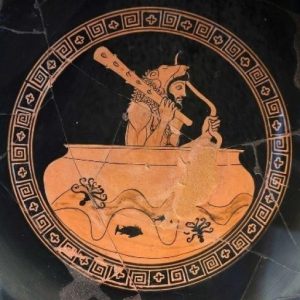
Grollios (1984) analyses this sixth-century BCE hydria featuring Heracles (standing) wrestling with Antaios (laying), while the gods watch (48). Image found here. The original watermarks have been removed, but this was only done so visitors could have an unobstructed view. This is for personal use only.

 Hercules Omnibus