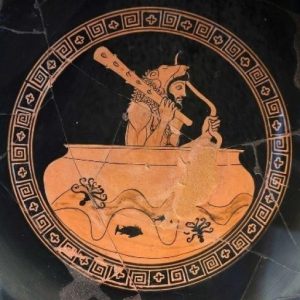
Pamela Jane Lawson, “The Iconography of Herakles and the ‘Other’ in Archaic Greek Vase Painting,” PhD diss., (Harvard University, 1993).
(Free PDF link above)
Abstract
The iconography of Herakles’ mythical biography on the surface of vases in the sixth century served as the medium through which Greek artists explored and made comprehensible the opposing forces of civilized and savage, or nature and culture. A close examination of the way in which the artists chose to illustrate Herakles’ deeds, helps the viewer today to understand the true nature of Greek anxieties and hopes about the forces operating in their world. Such forces and oppositions represented visually in the archaic period are eventually subsumed by the Greek/barbarian antithesis developed in the fifth century. Herakles represents the antithesis of the Greek vs. barbarian internalized. Herakles can behave in ways that will be considered ’barbaric’ in the next century. However, negative qualities most associated with the barbarian later, are externalized in many of Herakles’ deeds, confusing and confining the antithesis. The ‘monster’ or beast may have been a ‘proto-barbarian’, and particular deeds bring Herakles into contact with anthropomorphic foes who practice ‘barbaric’ behavior. In fifth century literature, Greek attitudes about the barbarian have transformed and expanded. The necessity for a more clarified image of the Greek/ barbarian antithesis is motivated by philosophical developments and historical events. The idea of the barbarian is externalized and defined by authors such as Herodotus. In Greek Tragedy, the barbarian is now often the foil for the civilized Greek. Because undesirable qualities are transferred to the non-Greek, attempts are made in literature to justify Herakles behavior and to make him a citizen of the polis. Representations of Herakles in fifth century art illustrate a similar transformation, despite the general decline in the appearance of scenes featuring Herakles in attic vase painting of the period. This decline may be related to the transfer of most negative qualities expressed in the sixth century images of Herakles to the barbarian of the fifth century. The advent of tragedy and the juxtaposition of the Greek and the barbarian provided a new way to illustrate the varied nature of humanity while additionally celebrating the Greek, making the sixth century iconography of Herakles obsolete.
 Hercules Omnibus