The Atlas-Heracles Strongman Figures of Greco-Buddhist Art

Note: This article discusses Asian art in the beginning but transitions to Greco-Buddhist and Greco-Roman art and myth.

I was “window shopping” on Facebook Marketplace, when I came across a listing (screenshot) for a lovely bronze of a muscular, squatting figure with a stern, mustachioed face (left and center). I recognized it as an example of strongman figures often seen supporting temple rooves across East and Southeast Asia. Compare it to this modern example from Taiwan (right) (thanks to this page).

This early-8th century CE Gana (dwarf) column support from Central Thailand (left) has a similar posture to the bronze (Guy, 2014, 49-50, cat. 17), as do figures on the base of the Western Pagoda (1237 CE) of Kaiyuan Temple in Quanzhou City, Fujian Province, China (right) (Ecke and Demiéville, 1935, plate 12).

Chinese figures are sometimes shown standing, such as on the early-12th century CE Tianning Temple Pagoda in Beijing, China (Boerschmann, 1912, plate 323). Their hands are upraised to help support the burden on their shoulders.

Ecke (1930) refers to these figures as Lishi (力士), which he translates as “‘vigorous knight’ or ‘hero'” (5). A quick Google search pulls up numerous related terms.1 I present them below in no particular order:

  • Fanzi kang miaojiao (番仔扛廟角) – “The foreigner who carries temple corners on his shoulders.”
  • Hanfan kang miaojiao (憨番扛廟角) – “The sturdy foreigner who carries temple corners on his shoulders.”
  • Hanfan kang cuojiao (憨番扛厝角) – “The sturdy foreigner who carries building corners on his shoulders.”
  • Dalishi kang wuji (大力士扛屋脊) – “The great strongman/Hercules who carries roof ridges on his shoulders.”
  • Hanfan dan liang (憨番擔樑) – “The sturdy foreigner that shoulders the roof beam.”
  • Lishi kang liang (力士扛樑) – “The hero/strongman who carries the roof beam on his shoulders.”
  • Hanfan kang dashan (憨番扛大杉) – “The sturdy foreigner who carries the fir tree (roof beam?) on his shoulders.”
  • Hanfan kang zhutou (憨番扛柱頭) – “The sturdy foreigner who carries the capital on his shoulders.”
  • Lishi kang zhutou (力士扛柱頭) – “The hero/strongman who carries the capital on his shoulders.”

The reason for the constant references to foreigners becomes clearer when you look into the history of this motif.

The Gana/Lishi strongmen hail from India, where they can be seen uplifting ancient stupa domes or gates and rock-cut cave architecture.2 As the Cleveland Museum of Art explains: “Repeated images of composite Atlas-like figures surrounded the base[s] of … stupas, which were solid domes, and can be understood as symbols for the sky, which would have appeared as though supported by rows of titanic figures.”

Multiple examples can be seen on the 1st century BCE/CE Western Gateway of the Great Stupa at Sanchi (left), as well as in the famous Ajanta Caves, like this sculpture (center) and this painting (right) from cave no. 17 (c. 500 CE).

The Gana/Lishi strongmen also appear in the 1st to 4th-century CE Greco-Buddhist art of Gandhara, in what is now modern day northwestern Pakistan to eastern and northeastern Afghanistan. But what’s interesting is that this type borrows imagery from the Greek titan Atlas, presenting the figure as a muscular, bearded, winged man3 sitting in a weight-bearing stance (this page has numerous samples). Here is a 3rd or 4th century CE example from Bonhams (left). Now compare it to the 2nd century CE Farnese Atlas (right). It’s easy to see similarities in their poses: one knee down, one knee up, and shoulders poised for bearing a heavy load.

This 2nd to 4th century CE Atlas figure sold by liveauctioneers (left) has a very similar posture to the aforementioned bronze (right).

It’s super fascinating to note that there are at least two Gandharan Atlas sculptures that conflate the titan with Heracles! One is from the Cleveland Museum of Art (left) and the other sold by Bonhams (center). The Nemean Lion hood, with paws tied at the chest, is a dead giveaway. Compare these to the 2nd-century CE Mathura Heracles (right), which depicts the hero paradoxically wearing the pelt and wrestling the lion at the same time (Cunningham, 1884, 109-110, plate 30).

Atlas and Heracles are likely conflated in Gandharan art because they are known for holding up the sky in Greek myth. The Bibliotheca (1st or 2nd century CE) of Pseudo-Apollodorus reads:

Now Prometheus had told Hercules not to go himself after the apples but to send Atlas, first relieving him of the burden of the sphere; so when he was come to Atlas in the land of the Hyperboreans, he took the advice and relieved Atlas. But when Atlas had received three apples from the Hesperides, he came to Hercules, and not wishing to support the sphere<he said that he would himself carry the apples to Eurystheus, and bade Hercules hold up the sky in his stead. Hercules promised to do so, but succeeded by craft in putting it on Atlas instead. For at the advice of Prometheus he begged Atlas to hold up the sky till he should> put a pad on his head. When Atlas heard that, he laid the apples down on the ground and took the sphere from Hercules (2.5.11).

The ancient Gandharan sculptors who created the Atlas-Heracles were surely aware of this myth and its similarities to the Gana/Lishi that bear the weight of the stupa’s sky dome (as noted above).

Those surprised by the appearance of Greek gods in Buddhist art would certainly enjoy reading about Heracles’ depiction as the Buddha’s loyal protector! See the papers archived on my primary blog.

Notes

  1. Many, if not all, of the Chinese names have concurrent Hokkien pronunciations and specific meanings, but I have only presented the pinyin as I’m not intimately familiar with the Southern Chinese language. ↩︎
  2. Coomaraswamy (1927) states that the “gana capital bec[ame] almost universal in mediaeval architecture” (76). ↩︎
  3. The wings of the Gandharan Atlas appear to be a characteristic unique to this school of religious art. According to the Cleveland Museum of Art, such figures were “given wings so as to appear superhuman.” ↩︎

Bibliography

Boerschmann, Ernst. Chinesische Architektur [Chinese Architecture]. 2 Vols. Otto v. Holten, 1912.

Coomaraswamy, Ananda Kentish. History of Indian and Indonesian Art. E. Weyhe, 1927.

Cunningham, Alexander. Report of a Tour in the Central Provinces and Lower Gangetic Doab in 1881-1882. Vol. 7. Calcutta: Office of the Superintendent of Government Printing, 1884.

Ecke, Gustav. Atlantes and Caryatides in Chinese Architecture. Catholic University of Peking, 1930.

Ecke, Gustav and Demiéville, Paul. The Twin Pagodas of Zayton: A Study of Later Buddhist Sculpture in China. Harvard University Press, 1935.

Guy, John. “Catalogue: Nature Cults.” In Lost Kingdoms: Hindu-Buddhist Sculpture of Early Southeast Asia, edited by John Guy, 40-51. The Metropolitan Museum of Art, 2014.

The Myths of Herakles as a Fighter – PDF

Grollios, A. D. “The Myths of Herakles as a Fighter.” Master’s thesis, University of Glasgow, 1984.

(Free PDF link above)

Thank you: I’m incredibly grateful to the University of Glasgow Library for scanning a physical copy of the thesis since the PDF I originally purchased from Proquest was flawed.

Summary

The present work examines the myths of Herakles as fighter, which are the myths where the hero appeared to confront a single opponent other than an animal or a monster. Those opponents are distinguished into Deities and Humans and the stories which narrate the fights of Herakles against them are classified accordingly into separate chapters in alphabetical order. A further distinction is made as regards the way the fights of Herakles were conducted: some of them involved the use of weapons but others were unarmed contests, almost exclusively wrestling matches. There is also a third chapter, which includes certain stories in which Herakles appeared to kill someone without a confrontation; those are called Killings and examined here because they still present the hero attacking a single individual. The stories under examination are reviewed as they appear in the sources; whenever the latter provide more than one versions [sic], those are all cited, irrespectively of their estimated validity. There follows an examination of various elements which are considered important in the stories, such as the way the contest between Herakles and his opponent was fought, the weapons which were possibly used, the result of the fight and its nature (whether a contest for a prize or a mere robbery, for example). The examination of all those myths where Herakles appears to fight a single individual leads to the conclusion that a significant number of Herakles’s opponents were either water-deities or descendants of Poseidon, the water-deity par excellence. That is taken to signify that Herakles should be ultimately considered a figure who is fundamentally opposed to water, a hero mostly suited to a non sea-faring people.

Grollios (1984) analyses this sixth-century BCE hydria featuring Heracles (standing) wrestling with Antaios (laying), while the gods watch (48). Image found here. The original watermarks have been removed, but this was only done so visitors could have an unobstructed view. This is for personal use only.

Heracles and the Old Man of the Sea – PDF

Luce, S. B. “Heracles and the Old Man of the Sea.” American Journal of Archaeology 26, no. 2 (1922), 174-192.

Conclusion

I have sought to show that the vases showing Heracles in combat with “Triton” and the vases with the hero attacking “Nereus” really are portraying the same exploit, the two forms of adversary to Heracles being two distinct manifestations of Halios Geron [“Old Man of the Sea”]; “Nereus” being Halios Geron as he appears on the oenochoe of Cholchos, and “Triton” being Halios Geron as he is represented on the Olympia plaque. There is, therefore, no particular difficulty regarding this class of vases, when the true interpretation is reached.

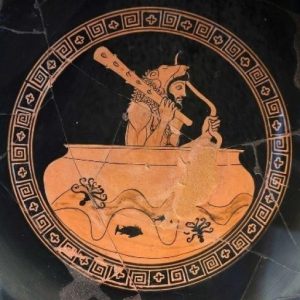
Color version of a mid-6th century BCE hydria featured in the paper (fig. 5, p. 179). It shows Heracles wrestling Triton, while Nereus watches. Image found here.

Heracles Contradictions

Here is a list of some of the Son of Zeus’ contradictions:

[G. S.] Kirk provides a useful summary list of some important contradictions:

humane [<–>] bestial
serious [<–>] burlesque
sane [<–>] mad
salutary [<–>] destructive
free [<–>] slave
human [<–>] divine

(to which Nicole Loraux adds

virile [<–>] feminine) (Lawson, 1993, 116-117)

Bibliography:

Lawson, Pamela Jane. “The Iconography of Herakles and the ‘Other’ in Archaic Greek Vase Painting.” PhD diss. Harvard University, 1993.

The Labours of Heracles: A Literary and Artistic Examination – PDF

Note: My blog is not monetized. The media below has been posted for educational purposes only. If you enjoyed this version, please, please, please support the official release.

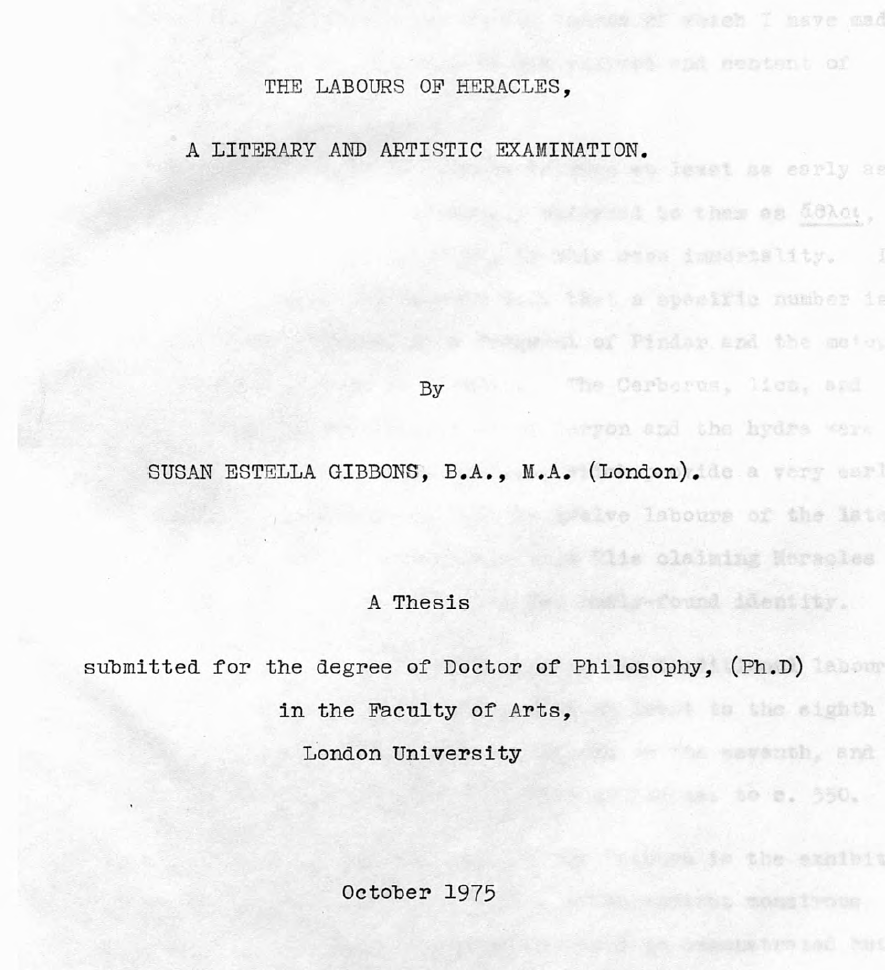
Gibbons, Susan E. “The Labours of Heracles: A Literary and Artistic Examination.” PhD diss. London University, 1975.

(Free PDF link above)

Abstract

This thesis is primarily concerned with the documentation of the artistic and literary evidence for each of the traditional twelve labours of Heracles, in the course of which I have made certain discoveries relating to the concept and content of the labours.

Heracles is made to perform labours at least as early as the Iliad. The Greeks generally referred to them as ἆθλοι, contests in return for a prize, in this case immortality. It is not until the fifth century B.C. that a specific number is defined, namely twelve, by a fragment of Pindar and the metopes of the Temple of Zeus at Olympia. The Cerberus, lion, and hind labours and possibly those of Geryon and the hydra were defined as such before the metopes, which provide a very early and isolated appearance of all the twelve labours of the later canon. I believe these metopes show Elis claiming Heracles as her special hero to emphasise her newly-found identity.

As regards the myths which became the traditional labours, Cerberus, lion, hydra and Geryon date at least to the eighth century B.C., birds and possibly Amazons to the seventh, and the rest, with the possible exception of Augeas, to c. 550.

The characteristic feature of the labours is the exhibition of heroism: most involve fighting, often against monstrous opponents. Sometimes public benefaction is demonstrated but this is developed more by later writers. Many heroic deeds of Heracles could have been made into labours. The choice at Olympia seems to demonstrate Heracles’ close connection with the surrounding area highlighted by the labours he performed. in the remote corners of the Greek world as a panhellenic hero, It was not until the local nature of Olympia’s interpretation of the individual labours was forgotten that it was adopted as the canon.

Hercules in Ibero-American Myth, History, and Art / Hércules en el mito, la historia y el arte iberoamericano – PDF

Note: My blog is not monetized. The media below has been posted for educational purposes only. If you enjoyed this version, please, please, please support the official release.

Pérez, José Luis, Varela, Sergio González, & Souberville, J. Armando Hernández, eds. Hércules en el Mito, la Historia y el Arte Iberoamericano. Relatos de una figura de poder y dominación [Hercules in Ibero-American Myth, History, and Art: Tales of a Figure of Power and Domination]. Mexico: El Colegio de San Luis – Universidad Iberoamericana, 2015.

(Free PDF link above)

The Herakles Theme – PDF

Last updated: 01-03-2026

Note: My blog is not monetized. The media below has been posted for educational purposes only. If you enjoyed this version, please, please, please support the official release.

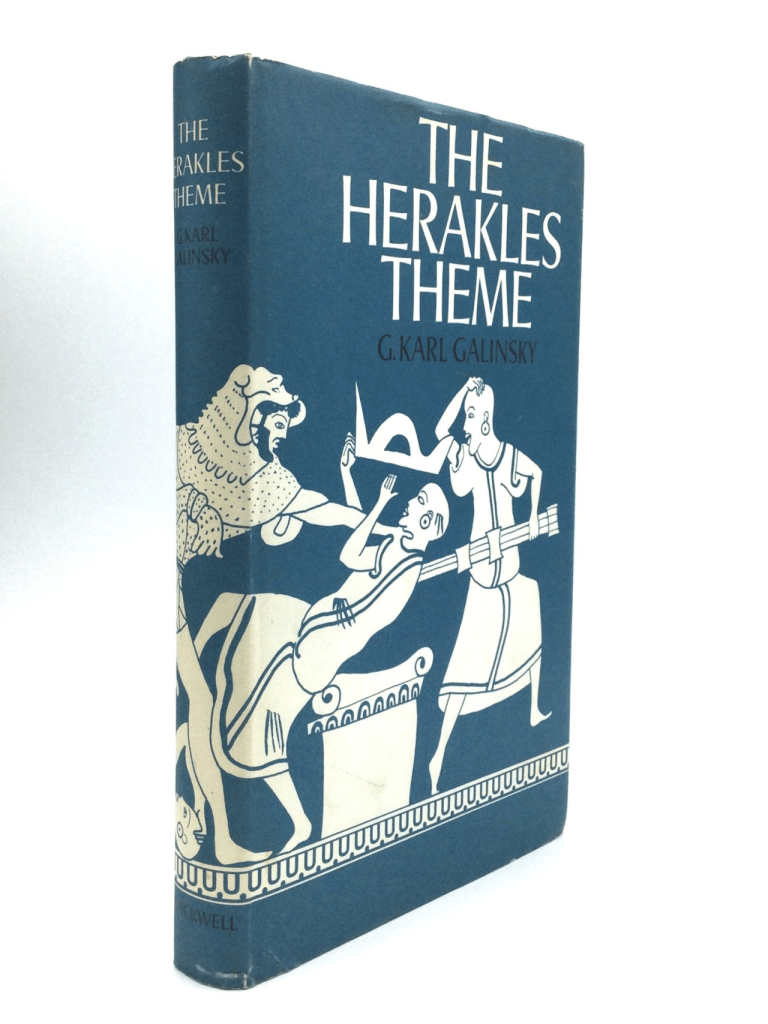
Galinsky, Karl. The Herakles Theme: The Adaptations of the Hero in Literature from Homer to the Twentieth Century. New Jersey: Rowman and Littlefield Publishers, 1972.

(Free PDF link above)

Blurb

Professor Galinsky’s “Herakles Theme” provides a survey both descriptive and analytical, of the most significant adaptations of Herakles in western literature, from Homer to present day, with particular emphasis upon the more original and creative portraits of the hero.

(Image from this listing)


Update: 01-03-26

I just started reading The Herakles Theme (1972), and the author mentions it was influenced by a previous book, so I figured I would add it here as well.

Stanford, W. B. The Ulysses Theme: A Study in the Adaptability of a Traditional Hero. 2nd ed. The University of Michigan Press, 1968.

(Free PDF link above)

(Image found here.)

Heracles vs Sun Wukong Drawings

Last updated: 01-05-2026

I commissioned two artists to draw Heracles fighting Sun Wukong (孫悟空), the immortal monkey hero from Journey to the West (Xiyou ji西遊記, 1592 CE). Both were instructed to draw the characters as if their combat was recorded by an ancient Greek vase painter. The images are for a DEATH BATTLE! response article on my alternate blog where I describe a more natural reason for the two warriors to come to blows.

First up is Dario Virga (Onibotokemaru on Instagram). Each figure is labeled in Greek: Heracles is “Ἡρακλῆς,” while Wukong is aptly called “Pithekos” (πῐ́θηκος), meaning “ape, monkey, trickster, or dwarf.” The latter is related to the Kerkopes, and it makes up part of the modern scientific name for Old world monkeys (Cercopithecoidea).

Here is an AI-enhanced version. It’s not perfect, but it’s a good proof of concept.

Second is Jacob King (Twitter, Instagram, & Tumblr). Again, the names are labeled—in this case Herakles and Sun Wukong. I suggested that the monkey be drawn in Greek armor since the scene is being viewed through a Greek lens. I love the cracks.

And here is an AI-enhanced version.


Update: 01-05-26

I came upon an interesting coincidence: Heracles and Sun Wukong in double-feather hats. The Son of Zeus is shown wearing a double-plumed hoplite helmet in the “Madrid Krater” (sometime between 350 and 320 BC) by Greek vase painter Asteas.

(Image found here)

And Sun Wukong has been associated with the “purple cap with phoenix wings/plumes” (fengchi zijin guan, 鳳翅紫金冠)” for centuries:

(Sun Wukong from the 1986 TV Series; image found here)

Great Ancient Greco-Roman Art Resource

While reading a PhD dissertation, I was pleasantly surprised to learn about the Lexicon Iconographicum Mythologiae Classicae (“Iconographic Lexicon of Classical Mythology”; a.k.a. LIMC; 1981-2009). It is a 16-volume encyclopedia of ancient Greek, Roman, and Etruscan art showcasing historical examples for each deity. The books cover gods alphabetically, starting with “Atherion-Eros” and ending with “Thespiades-Zodiacus.”

(Image found here)

The tomes are presented in pairs of eight matched volumes, the first comprising articles describing the art and the second with pictures.

I would LOVE to get physical copies, but they are very expensive. Thankfully, there are options. First, black and white PDFs of the full series are available on Internet Archive. (See below for a screenshot of a couple of pages (of many) focusing on Heracles.)

https://archive.org/details/limc_20210516/Lexicon%20Iconographicum%20Mythologiae%20Classicae/LIMC%20I-1/

And second, there is a searchable website.

https://app.dasch.swiss/project/BRwvcfLLT72IN-fXzQkrdQ/data

Admittedly, though, I would rather flip through pages of the physical books.